Flip and Flop
| Flip and Flop | ||
|---|---|---|
 | ||
| Game No. | 514 | |
| Voting | 6.80 points, 5 votes | |
| Developer | Jim Nangano | |
| Company | First Star Software | |
| Publisher | State Soft | |
| Musician | Jerry White | |
| HVSC-File | /GAMES/A-F/Flip_and_Flop.sid | |
| Release | 1984 | |
| Platform | Atari 400/800, C64 | |
| Genre | Arcade | |
| Gamemode | Single player 2 players (in turns) | |
| Operation |   
| |
| Media |  
| |
| Language | 
| |
Description[edit | edit source]

In the game Flip and Flop, the player alternately controls Flip the kangaroo and Mitch the monkey across a playing field made up of individual platforms connected by ladders. These platforms are composed of square sections, some of which are marked with a white circle. The goal of each level is to land on all the sections with such a circle within a limited time, thus turning them completely white. From the third level onward, the kangaroo must beware of a zookeeper who wants to capture it, while Mitch the monkey is pursued by a net. With some skill, however, these pursuers can be lured onto sticky sections in the middle of the platforms, rendering them harmless for a few seconds.
 |
 |
Backstory[edit | edit source]


Flip the kangaroo and Mitch the monkey live happily with their friends in the circus until one day they are transported to the "Zoo of the Future" and imprisoned there. Fortunately, they both manage to escape — but the way back is complicated and long, and their escape is soon noticed: A zookeeper chases the runaway kangaroo, and a net is used to try and recapture the monkey. However, after every five stages of their escape, a magical ladder appears, which takes them back to the circus for a short time, where they are warmly welcomed by their friends and celebrated with tricks.
Design[edit | edit source]
During the game, the portion of the game board on which the player-controlled character (Flip the kangaroo or Mitch the monkey) is located is always visible against a black background. Pixel-by-pixel scrolling ensures that the character remains centered on the screen as it moves. The platforms that make up the game board are brightly colored, reflecting the animals' desire to return to their friends at the circus. While in the early levels the game board is only slightly larger than the visible portion of the screen, in later stages only a small part of it is visible, requiring patience and careful planning to find and enter all the marked spaces. Both the animals' movements and individual events, such as falling off a platform, are constantly accompanied by short sound effects.
 |
 |
 |
Graphics[edit | edit source]
The game board is displayed in multicolor text mode (character set at address $5000, video RAM at $4000). Interestingly, not only are two sprites used to display the game characters (Flip and the zookeeper, and Mitch and the net), but the score above and the high score below the game board are also displayed entirely with sprites. This way, all displays remain in their fixed positions, even when the game board is scrolled horizontally or vertically.
Sound[edit | edit source]
The start screen and bonus animations are accompanied by three-part music reminiscent of circus performances. During gameplay, only the jumping sounds of the kangaroo and monkey are usually heard; otherwise, individual events such as the beginning and end of a level and the end of the game are underscored by short, monophonic melodies. The sounds are fitting for a game from the early 1980s, but nevertheless become monotonous and intrusive after a short time.
Hints[edit | edit source]
The goal of each level is to move the player character (Flip the kangaroo or Mitch the monkey) to all the spaces on the game board marked with a white circle until they appear completely white. In the early levels, it is sufficient to land on the spaces once, while in later levels, the circle sometimes transforms into a cross before becoming a white space upon the next landing. Each change of color in a field — both to the intermediate level marked with a cross and to a completely white area — is rewarded with 25 points.
The time available to complete this task is recalculated in each round (from 50 seconds in the first levels to 186 seconds in the later levels) and is usually quite short. It is therefore advisable to carefully plan your route across the individual platforms of the game board and, in particular, to avoid the flashing spaces, as the player's character will get stuck on these for a short time, thus losing valuable seconds.
If all spaces are correctly recolored, the remaining time is converted into points (5 points per remaining second) and awarded to the player. If the escape fails because the character is caught or falls over the edge of a platform, the level ends and must be continued with a new attempt from the point the character reached in the previous round. If the available time expires before all spaces have been recolored, the player must even restart the level from the beginning. A total of 5 attempts (corresponding to 5 lives) are available at the start of the game. For each successfully completed round, there is an extra life.
The two characters, Flip the kangaroo and Mitch the monkey, alternate from level to level, with both characters having to navigate the same game board in consecutive rounds (see the following illustrations, shown on a white background for clarity). However, Flip jumps on the platforms, which are shown from above, while Mitch swings along the platforms, which are shown from below.
 |
 |
 |
 |
Screen Layout[edit | edit source]
 |
 |
Controls[edit | edit source]

From the start screen, the game can be started by pressing the F1 key.
Alternatively, the number of players and the number of joysticks used can be set here; possible settings are "1 player with 1 joystick", "2 players with 2 joysticks", and "2 players with 1 joystick". To switch between these configurations, you must wait until the game enters Attract Mode (i.e., until either Flip the kangaroo or Mitch the monkey moves across the game board); then press the F5 key repeatedly until the desired configuration is displayed in the bottom line of the screen.
By repeatedly pressing F3 , you can also select the starting level from 1 to 13.
Once the game has started, the controls are only available via the joystick. Although the player-controlled character moves diagonally across the playing field, it is sufficient to move the joystick in one of the main directions:
 : The character moves to the right and back
 : The character moves to the left and back
 : The character moves to the right and forward
- : The character moves to the left and forward


Tips[edit | edit source]
- If you find it bothersome that moving the joystick vertically and horizontally results in diagonal movements of the character, you can rotate the joystick 45° clockwise so that the directions of movement of your hand and the character coincide.
- If the player character is on a platform accessible only by a single ladder, thus creating a "dead end," and the pursuer approaches, the player can escape by leaving the platform via the ladder at the exact moment the pursuer enters the platform from the other end of the ladder: In this case, Flip and the zookeeper, or Mitch and the net, jump past each other.
Solution[edit | edit source]
In the first two levels, "Flip and Flop" is easy to play, as neither the circus keeper nor the net appears. Even in the following levels, the pursuers are not yet a great danger, as they move slowly and are easily lured onto sticky surfaces — however, practice and skill are essential for a good result. A solution to the game — for example, Flip and Mitch permanently returning to their friends at the circus—is not provided: After 36 rounds, the game simply ends.
For those players who, despite all their efforts, fail in the first few rounds, the following gallery shows the actions and tricks with which kangaroo Flip and monkey Mitch are greeted by their friends at the circus upon successful completion of the levels divisible by 5:
 |
 |
 |
 |
 |
 |
 |
Similar "show acts" that reward the player after a certain number of levels can also be found in other games from the first half of the 1980s, for example, "Astro Chase" and "Spare Change".
Cheats[edit | edit source]
There is a Crack by Hokuto Force on CSDb with a whole range of Trainer functions.
 |
Votes[edit | edit source]
| Voting of the C64-Wiki users (10=the best vote): | ||
| 6.80 points at 5 votes (rank 555). You need to be logged in to cast a vote. | ||
| C64Games | 6 | 24. Sep 2025 - "gut" - 20093 downs |
| Ready64 | 8,00 | 24. Februar 2025 - 3 voti |
| Lemon64 | 7,33 | 23. Februar 2025 - 42 votes |
| Universal Videogame List | 3.9/5 | 22. Februar 2025 |
| Computer and Video Games | Getting started 7/10, Graphics 7/10, Value 6/10, Playability 7/10 | Issue 36 (October 1984) |
| Commodore Horizons | Graphics 9/10, Sonics 9/10, Gameplay 9/10 | Issue 10 (October 1984) |
| Home Computing Weekly | 5/5 (Instructions 95%, Ease of use 80%, Graphics 95%, Value for money 95%) | Issue 80 (Sept. 18-24, 1984) |
| Personal Computer Games | 7/10 (Graphics 8/10, Sound 7/10, Originality 6/10, Lasting interest 7/10) | Issue 12 (November 1984) |
| Popular Computing Weekly | 4/5 | Issue 128 (11-17 October 1984) |
| TV Gamer | Value 3/5, Graphics 3/5, Sound 3/5, Gameplay 4/5 | Issue 12 (November 1984) |
| Your Commodore | 5/5 | Issue 3 (December 1984) |
| Micro 7 | Présentation 4/6, Originalité 2/6, Graphisme 5/6, Durée de vie: 3/6, Qualité/Prix: 3/6 | Issue 15 (Avril 1984) |
| Rombachs C64-Spieleführer | 7 | September 1984 - "Verdict 2" |
Critics[edit | edit source]
Stephan64: "Flip and Flop is a very well-made platformer that will keep you busy for a long time. The fact that the game boards become more complex from level to level, but not necessarily more varied, is compensated for by the attractive animations that appear after every 5 successful levels, which you can look forward to while playing. I give it 6 points for a carefully programmed computer game that, considering its early release year, represents a truly remarkable achievement."
Rombachs C64-Spieleführer: "An original variation of the Q-bert game, which shines especially in its graphics. (Rating 2)." [1]
Miscellaneous[edit | edit source]
Cover[edit | edit source]
 |
Inlay[edit | edit source]
 |
Cassette[edit | edit source]
 |
Fastloader[edit | edit source]
The cassette version of "Flip and Flop" uses an integrated software fast loader that is automatically activated when loading and speeds up the loading process by a factor of approximately 4.5. This fastloader is stored in encrypted form in the header of the program stored on the cassette, meaning it is transferred to the cassette buffer as soon as the filename is located. The program itself is just a short routine that then decrypts and executes this fastloader. Furthermore, this program is responsible for destroying the fastloader after it has finished, so that a subsequent reading of the cassette buffer does not reveal its operation. During the loading process, the screen usually displays a horizontal striped pattern; occasionally, the loading screen shown below is also visible.
The fastloader is capable of loading up to 256 individual program parts sequentially. Each such file is preceded by a 4-byte data structure containing the start and end addresses of the following data block. Thanks to optimized encoding (shorter intervals for 0 and 1 bits, no parity bit and byte, no duplicate storage of program data), loading "Flip and Flop" takes about two and a half minutes, whereas the KERNAL's datasette routines would take almost 11 minutes for a file of this size.
Almost as interesting as the fast loader is the routine that decodes it before it is used. To obscure its exact workings, this decoder uses a large number of illegal opcodes (mostly NOPs) and therefore initially appears, upon disassembly, more like a random block of data than executable code. This program segment is loaded into the memory area $02A7...$030B and overwrites two BASIC vectors there, causing it to start immediately after loading.
The same fastloader is also used in the cartridge versions of the games Astro Chase, Aztec, Bristles, and Starquake.
 |
Theme[edit | edit source]
The following gallery shows the title theme and the short sequences that underscore individual events in the game, in standard musical notation. For creative reuse, the sheet music is also available as a PDF document (File:FlipAndFlop Theme PDF.pdf) and in ABC musical notation (File:FlipAndFlop Theme.abc.txt).
 |
 |
Video Recording[edit | edit source]
Longplay of the game
Highscore[edit | edit source]
The following list invites you to immortalize yourself with your highest score. The game should be played from level 1 onwards. The last level played can be included; however, the ranking is determined solely by the score achieved.

- Ivanpaduano - 13.415 - 14 (05.09.2023)
- TheRyk - 6.250 - 8 (15.12.2025)
- Stephan64 - 6040 - 8 (14.03.2025)
- Shakermaker303 - 2510 - 3 (18.10.2025)

|

|
|||
| #2 TheRyk | #3 Stephan64 |
-
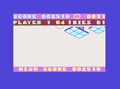 #4 Shakermaker303

Links[edit | edit source]

|
Wikipedia: Flip_and_Flop |
- C64Games.de - Game No. 1704

- Gamebase64.com - Game No. 2816
- CSDb (all entries)
- Lemon64 - Game No. 943
- C64.com - Game No. 178
- ready64 - Game No. 1995

- Flip and Flop at MobyGames


- Magazine
- 64er test report (pp. 48)
- Computer and Video Games test report (p. 36)
- Commodore Horizons test report (p. 19)
- Home Computing Weekly test report (p. 15)
- Micro 7 test report (p. 116)

- Personal Computer Games test report (p. 53)
- Popular Computing Weekly test report (p. 21)
- TV Gamer test report (p. 47)
- Your Commodore test report (p. 53)

Sources[edit | edit source]
- ↑ Oswald Reim, Martin Scholer: "Rombachs C64-Spieleführer", Rombach, 1984, page 126
