Suicide Strike
| Suicide Strike | ||
|---|---|---|
 | ||
| Game No. | 545 | |
| Voting | 7.20 points, 5 votes | |
| Developer | Graham McKay | |
| Company | System 3 Software Ltd. | |
| Publisher | Tronix Publishing Inc., System 3 Software Ltd. | |
| Musician | Arti Haroutunian | |
| Release | 1983 | |
| Platform | C64 | |
| Genre | Shoot'em Up, Simulation, Action | |
| Gamemode | Single player | |
| Operation |  
| |
| Media |  
| |
| Language | 
| |
| Information | [2] | |
Description[edit | edit source]


Suicide Strike is a shooting game in which the player controls a fighter jet over a three-dimensional landscape. Within a time limit of 10 minutes, the player must destroy three enemy radar bases, eliminating enemy attack helicopters, tanks, and fighter jets along the way. After each radar base, these enemies become faster and more numerous. The game ends when the mission is completed and all radar installations are destroyed, or alternatively, when the time limit is reached, or when all six fighter jets in the player's squadron have been shot down.
Backstory[edit | edit source]
In an unspecified military conflict, the commander of a squadron of six fighter jets volunteered for the mission to destroy three enemy radar bases. Because of the great distance that needs to be covered, the fuel on board must be used sparingly by reducing the flight speed; it will certainly not be enough to return to the home base.
According to scouts, enemy attack helicopters, fighter jets, artillery, and heat-seeking missiles are to be expected on the way to the radar bases. Furthermore, the mission must be completed within 10 minutes to avoid a retaliatory strike by the enemy.
Design[edit | edit source]
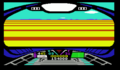
The flight to the radar bases is displayed on a split screen. The upper part shows a view through the windows of a fighter jet of the landscape being flown over, while the lower part shows the instruments in the jet's cockpit. Because the approaching enemies, the structures on the earth's surface, and the clouds in the sky become larger as they approach, and because the mountains on the horizon react to the jet's lateral movements with a slow horizontal shift, the landscape appears surprisingly three-dimensional.
 |
 |
 |
Graphics[edit | edit source]
The graphics are displayed entirely in multicolor text mode (screen memory at address $7400). The character set for displaying the cockpit and the overflown landscape (text lines 1-18) is located at address $7000, while the character set for displaying the instruments (text lines 19-25) is located at address $7800. The pilot's own aircraft, as well as enemies, projectiles, explosions, shadows, clouds, and some parts of the cockpit, are represented by sprites.
The horizontal yellow and brown stripes that give the landscape its three-dimensional appearance are created by first setting the background color (VIC register $D021) to yellow and then setting the entire screen area occupied by the landscape to brown in the color RAM. Each of the text lines that make up the landscape (lines 8–18) is filled with a different character (character code $6E–$78). The three-dimensional representation is then simply created by periodically overwriting the definitions of these characters in the character generator with a moving stripe pattern.
When the player-controlled jet flies a turn, the mountains on the distant horizon scroll slowly to the left or right. Since the black border of the windshield is represented by sprites in these raster lines, it is not affected by the horizontal scrolling.
The detection of own and enemy hits is based on the collision detection of the VIC (Register $D01E).
Sound[edit | edit source]
The game's musical accompaniment consists of a three-part melody that plays during the intro and after successful mission completion, and two short sequences at the start of the game and after mission failure. During gameplay, only sound effects representing engine noises, gunfire, and explosions are heard; furthermore, a warning beep at the beginning of each minute and during the final seconds reminds the player of the tight time limit.
Hints[edit | edit source]
Controls[edit | edit source]
Pressing the F3 key pauses the game, and pressing it again resumes it.
In the game itself, the fighter jet is controlled with a joystick in port 2; the following mapping applies:
 : Fires a missile in the direction of flight.
 : Fighter jet flies left/right.
 : Fighter jet climbs (to engage enemy jets or helicopters at higher altitudes).
 : Fighter jet descends (to destroy enemy tanks near the ground).
 : Decrease speed.
 : Increase speed.


Screen Layout[edit | edit source]
The following illustration shows the screen layout during gameplay. It consists of the cockpit and its displays, as well as the depiction of the landscape being flown over and the combat action. For gameplay purposes, only the rearview mirror in the cockpit is relevant, as it indicates approaching kamikaze aircraft. Otherwise, it is sufficient to focus solely on the view through the windshield during gameplay.

Enemies[edit | edit source]
At the controls of his fighter jet, the player must not only destroy the three radar bases mentioned in the mission order, but also first overcome four groups of enemies. It is particularly important to adjust the altitude to the current adversary:

Attack helicopters can only be engaged if the player is flying their jet at maximum altitude. Conversely, the jet cannot be hit by enemy fire while flying close to the ground. Shooting down an attack helicopter is rewarded with 1000 points.

Tanks, on the other hand, can only be shot down while flying close to the ground; however, their projectiles can reach the player's fighter jet at any altitude. Destroying a tank also awards 1000 points.

As with helicopters, engaging fighter jets requires the player to fly their aircraft at maximum altitude; otherwise, the missiles fired by opponents will miss their target. Shooting down a fighter jet is worth 2000 points.

Kamikaze planes dive-bomb the player's jet from behind, at any altitude. Therefore, altitude is irrelevant during this phase of the game. Shooting down one of these planes also awards 2000 points.

Radar stations can be attacked from any altitude. Each destruction of a radar station is generously rewarded with 10,000 points.
Tips[edit | edit source]
- None of the enemy missiles are "heat-seeking", as claimed in the mission order. Rather, all enemies fire in the direction of the player's current position — and the simplest way to avoid this is to fly a constant zigzag course.
- Since the enemy fighter jets move more slowly when approaching than the perspective would suggest, they are easiest to engage at close range.
- Kamikaze aircraft attacking from behind can be avoided by making the fighter jet perform a constant sideways movement as soon as the attacker reaches its maximum size in the rearview mirror.
- It is not recommended to fly faster than the minimum speed. Higher speeds make the game more difficult, while the 10-minute time limit is usually not used up and is therefore meaningless.
Solution[edit | edit source]
Suicide Strike can be played successfully simply by shooting down opponents early and simultaneously dodging them and their projectiles in time. However, the difficulty level increases so much as the game progresses that, if at all possible, the game can only be "solved" with a great deal of practice, and the three enemy radar bases must be completely destroyed within 10 minutes.
Cheats[edit | edit source]
In the CSDb, there is a crack by the group Hokuto Force with a trainer function:

Internal Data Structures[edit | edit source]
Knowledge of memory allocation and internal workings is helpful for developing custom trainer functions and for analyzing or manipulating the data used by the game. The following table therefore compiles a range of information about "Suicide Strike". Unfortunately, the cracks available on the World Wide Web are usually compressed in various ways, so the information listed here cannot be exploited, or only in a modified form, by a single poke.
| Adresse | Inhalt | Bemerkungen |
|---|---|---|
| $8D21 | Number of remaining fighter jets | Counts down at address $995E. Replacing the opcode of "DEC abs" ($CE) at this point with that of "BIT abs" ($2C) grants unlimited lives.
$995E: DEC $8D21 $9961: BPL $996C |
| $8CDD | Fuel level (BCD) | Required for the decimal fuel gauge; the game ends when the value reaches 0. If you replace the step size $01 at address $A226 with $00, the aircraft will no longer consume any fuel:$A220: SED $A221: LDA $8CDD $A224: SEC $A225: SBC #$01 $A227: CLD $A228: BCC $A26E $A22A: STA $8CDD |
| $8CDE | Fuel level (binary) | Required for the graphical display of the fuel level; otherwise, it has no effect on gameplay. It can be disabled for visual reasons by replacing the opcode of DEC abs ($CE) with that of BIT abs ($2C):$A252: DEC $8CDE |
| $86F0/$86F1 | Time remaining (minutes/seconds) | Counts down from address $AAE2; the game ends when the remaining time reaches 0:00, thus reaching the time limit. If you replace the step size $01 at address $AAE7 with $00, there is no longer a time limit:$AAE1: SED $AAE2: LDA $86F1 $AAE5: SEC $AAE6: SBC #$01 $AAE8: BCS $AAF1 ... $AAEF: LDA #$59 $AAF1: STA $86F1 $AAF4: LDA $86F0 $AAF7: SBC #$00 $AAF9: STA $86F0 $AAFC: CLD $AAFD: BCS $AB08 |
Votes[edit | edit source]
| Voting of the C64-Wiki users (10=the best vote): | ||
| 7.20 points at 5 votes (rank 410). You need to be logged in to cast a vote. | ||
| Commodore User | Presentation 3/5, Skill Level 2/5, Interest 1/5, Value for money 2/5 | Ausgabe 18 (March 1985), S. 53 |
| C64Games | 6 | August 25, 2022 - 19789 downs |
| Ready64 | 6,5 | August 25, 2022 - 4 voti |
| Universal Videogame List | 2/5 | 18. Februar 2023 |
| Rombachs C64-Spieleführer | 8 | September 1984 - "Verdict 2" |
Critics[edit | edit source]
Stephan64: "Actually a simple shooter, which becomes far too difficult and therefore quite hectic as the game progresses. However, its creators make remarkably clever use of the VIC's capabilities for the three-dimensional display — and this was in 1983! Therefore, hats off to them and 6 points."
Rombachs C64-Spieleführer: "An interesting shooting game for more discerning players (Rating 2)." [1]
Miscellaneous[edit | edit source]
Cover[edit | edit source]

Inlay[edit | edit source]

Cassette[edit | edit source]

Theme[edit | edit source]
The musical score consists of a melody that plays during the intro and after the successful completion of the mission, and two short sequences at the start of the game and upon mission failure after the last fighter jet is shot down. The following gallery shows these musical pieces in standard musical notation. For creative reuse, the sheet music is also available as a PDF document (File:SuicideStrike Theme PDF.pdf) and in ABC musical notation (File:SuicideStrike Theme.abc.txt).
 |
 |
Video Recording[edit | edit source]
Short and fairly successful demonstration
Fastloader[edit | edit source]
The cassette version of "Suicide Strike" uses the Novaload fast loader. In the scrolling text displayed on its loading screen (middle image in the gallery below), System 3 not only advertises other games from its own company but also seeks talented programmers: "ALSO FROM SYSTEM 3 - JUICE!, MOTO CROSS, DEATHSTAR INTERCEPTOR. COMING SOON DISCUS AND TWISTER..... PROGRAMMERS CAN YOU PROGRAM TO OUR STANDARDS FOR THE HIGHEST REWARDS? SEND A SAMPLE TO SOFTWARE DEVELOPMENT MANAGER SYSTEM 3 SOFTWARE. SOUTH BANK HOUSE, BLACKPRINCE ROAD LONDON SE 1."
During loading, a three-part melody shortens the waiting time (right image in the gallery). For creative reuse, the sheet music is also available as a PDF document (File:SuicideStrike Loader PDF.pdf) and in ABC musical notation (File:SuicideStrike Loader.abc.txt).
 |
 |
 |
Highscore[edit | edit source]

- Riffislam - 191.000 (05.02.2023)
- Ivanpaduano - 188.000 (11.01.2023)
- Stephan64 - 168.000 (29.08.2022)
- Keule - 154.000 (30.11.2023)

|

|
|||
| #2 Ivanpaduano | #3 Stephan64 |
-
 #4 Keule

Links[edit | edit source]
- Gamebase64.com - Game No. 7541
- C64Games.de - Game No. 1517
- Lemon64 - Game No. 4031
- C64.com - Game No. 365
- CSDb
- ready64 - Game No. 726

- Suicide Strike at MobyGames

Videos[edit | edit source]
Sources[edit | edit source]
- ↑ Oswald Reim, Martin Scholer: "Rombachs C64-Spieleführer", Rombach, 1984, page 343
