Alice in Videoland
| Alice in Videoland | ||
|---|---|---|
 | ||
| Game No. | 534 | |
| Voting | 6.33 points, 6 votes | |
| Developer | John A. Fitzpatrick | |
| Company | Audiogenic | |
| Publisher | Audiogenic, Bug-Byte, Artworx, Maynard International (Top Ten) | |
| Musician | John A. Fitzpatrick, HUMM[1] | |
| HVSC-File | /MUSICIANS/F/Fitzpatrick_John/Alice_in_Videoland.sid | |
| Release | 1984 | |
| Platform | C64 | |
| Genre | Arcade | |
| Gamemode | Single player up to 4 players (in turns) | |
| Operation |   
| |
| Media |  
| |
| Language | 
| |
| Information | Distributed in the USA by Artworx Sequel: Alice in Videoland - The Further Adventures | |
Description[edit | edit source]
"Alice in Videoland", also simply "Alice" in the title image, is a computer game with a total of 4 levels in which the player controls the character Alice, the title character of Lewis Carroll's books "Alice's Adventures in Wonderland" and "Through the Looking-Glass", and must solve simple tasks. The total points earned in this way serve as a measure of the player's performance at the end of the game. There is no overarching goal or objective.
Backstory[edit | edit source]
...has no overarching narrative; it is simply a series of scenes that incorporate episodes and characters from the books "Alice's Adventures in Wonderland" and "Through the Looking-Glass." The tasks to be completed are varied and include collecting objects, a simple game of chess, and a pinball simulation. However, they do build upon each other to some extent, as Alice gathers resources that she can then use later.
Design[edit | edit source]
The gameplay is almost exclusively rendered using sprites, while the background only changes color and rarely interacts with the game elements.
 |
 |
 |
Graphics[edit | edit source]
The background images of the individual levels are sometimes elaborate and lovingly designed. They are displayed in Extended Color Text mode (Level 1, character set at address $7000, video RAM at address $7800), in Multicolor Graphics mode (Level 2, bitmap at $6000, video RAM at $5C00), or in Multicolor Text mode (Levels 3 and 4, character set at $7000, video RAM at $7C00). Multicolor sprites are used for most moving elements; Alice, for example, is composed of up to three such sprites. Only the black smoke rings that the caterpillar blows into the air in the second level are incorporated into the background graphics.
In the first two levels, the detection of collected objects and enemy contact is mostly based on the collision detection of the VIC (register $D01E). Only a collision with the caterpillar's smoke ring in Level 2 is detected without hardware support.
Sound[edit | edit source]
The gameplay is accompanied by six rather pleasant melodies, played using the "Micropearl Music Player" developed by John A. Fitzpatrick. However, the music is sometimes interrupted in a very distracting way by sound effects that underscore the gameplay.
Hints[edit | edit source]
At the beginning of the game, Alice follows a white rabbit down its burrow and, controlled by the player, must complete various tasks in four consecutive levels. The duration of these levels varies depending on the player's skill and approach, but their sequence always remains the same.
Controls[edit | edit source]

After loading, a configuration screen allows the player to set the difficulty level (in the range 0-9), the number of players (1-4), and their initials using the keyboard. The difficulty level affects the number of obstacles and enemy projectiles, as well as the speed and movement range of the enemies. Alice's attributes and abilities, however, are unchangeable.
Furthermore, the current score can be checked at any time — even during gameplay. If multiple players are active, you can switch between their scores:
- F1 : Set options (number of players, player initials, difficulty level)
- F5 : Switch between players
- F7 : Show high score (exit with RETURN )
The game itself is then controlled with a joystick in port 2, partially supported by the function keys. After a short wait, once the scene with Alice under the tree in the garden appears, pressing the fire button starts the opening sequence. Upon reaching the rabbit hole, Alice jumps after the rabbit after a second press of the fire button. If this action is omitted, the game returns to the title screen with the configuration options after a short time.
During the game, Alice moves in the direction the joystick is moved. Additional control options vary from level to level and are therefore described in detail in the following explanations of each level.
Level 1: Opening Doors[edit | edit source]
The first level is divided into two parts. After falling through the tunnel at the entrance to the rabbit hole, Alice continues to fall for a while through a long, brightly tiled room. The goal in this phase is to collect cakes, bottles, and keys flying around, as these are worth 10 points each and can also be useful to Alice later. To carry more than one item, Alice should first grab one of the baskets floating around at the beginning of the level as quickly as possible. It is also important to avoid contact with obstacles: If Alice touches a picture of a rabbit, she is slowed down and cannot collect any objects, and if she collides with a lamp, she loses all the items she has already collected.
 |
 |
 |
Once at the bottom, Alice must unlock and go through as many doors as possible. To do this, she must first shrink to the size of the door using the cakes and bottles she collected earlier, and then open the door with a key of the corresponding color from the previous stage. In the screen setup described below, for example, Alice is clearly too big for the light red door and must shrink several times before she can fit through it.
Alternatively, Alice can catch one of the floating cakes to grow a little bigger or collect passing bottles to shrink herself gradually. If Alice is hit by the rabbit's fan, which also occasionally passes by, she instantly becomes oversized and must shrink by at least one step before she can fit through one of the doors again.
If Alice didn't bring a key of the correct color from the first stage of the level, she can instead grab one of the white keys that keep whizzing by and use it to open a door. However, each white key can only unlock one door at a time, while the colored keys from the first phase of the game can be reused indefinitely.
In some places, glass tables block Alice's path. Contact with the clock that flies by from time to time must be avoided, as otherwise the level ends immediately.
Additional controls in this phase of the game are:
- F3 Eat a cake brought from the first phase of the level to grow larger
- F5 Drink a bottle collected in the first phase to shrink
 |
 |
 |
Level 2: Catching Rocking Horses and Butterflies[edit | edit source]

Alice has arrived in a colorful garden with flowers and mushrooms and must collect as many flying rocking horses as possible by jumping from the highest mushroom. When Alice returns to the ground, each rocking horse she has collected is released and transforms into a ball that rolls away and will be useful later, two levels ahead. The butterflies can also be collected. While the rocking horses each award 100 points and a ball, catching a butterfly is only worth 10 points.
If Alice is hit by one of the projectiles fired by the flowers or by the caterpillar's smoke rings, she shrinks to half her size and can no longer jump. The small mushrooms in the bottom right corner of the screen can help in this case: if Alice goes to them and eats one, she regains her original size. Once the small healing mushrooms are used up, the level ends.
The level offers the following additional control option:
- Make Alice jump, for example, onto the large, central mushroom, from which the flying rocking horses can be reached.
 |
 |
 |
Level 3: Chess[edit | edit source]
Supported by two white knights, Alice must reach the other side of the board. Her opponents are the dragon Jabberwocky and the twins Tweedledee and Tweedledum. Jabberwocky first tries to capture the two knights and then Alice, while the Tweedle twins block Alice's path and repeatedly push her back.
Alice can move forward on the board, analogous to the pawn in chess; in addition, she can move left and right. She moves quickly sideways, while moving forward is very slow. Only one of the knights can be controlled at a time, while the second remains stationary as a reserve; as in chess, the knights move two squares in one direction, followed by a perpendicular move of one square. Jabberwocky can move any number of squares horizontally, vertically, or diagonally on each move, analogous to the queen in chess. The Tweedle twins correspond to the white and black bishops; they move diagonally in one-square increments.
Jabberwocky announces an impending move with a vigorous flapping of its wings. At that moment, the currently active knight must move to a square that the dragon cannot reach in one move. To do this, the knight places the cursor (represented by a cloud of dots) on a target square that is not under threat from the dragon and moves the knight there by pressing the fire button. Alternatively, the knight can capture Jabberwocky once it is no longer on its starting square at the top of the board. To do this, the knight moves to the dragon's current location. Jabberwocky is then defeated and — turning bright green with rage — must return to its starting square and remain there for a certain period of time. Tweedledee and Tweedledum can also be captured and must then remain in one of the top corners of the board for a certain period of time. However, the more often all enemies have been defeated, the more agile and aggressive they become.
If the player fails to get the active knight to safety before Jabberwocky attacks, the dragon will defeat the knight. If both knights are lost, Alice is defenseless and can also be defeated by the dragon. To make matters worse, the twins Tweedledee and Tweedledum repeatedly block Alice's path and push her back.
The controls in this level are as follows, using the joystick:
 Pressing the fire button displays a point cloud cursor indicating the currently active knight; Alice is now inactive. Pressing the fire button again restores control of Alice.


 If Alice is active, she can be controlled as usual. If, however, you are currently controlling the white knight, you can move the joystick to point the cursor to the square the knight should move to next. Pressing the fire button then executes the desired move before control returns to Alice.


 |
 |
 |
Level 4: Croquet[edit | edit source]
Alice must keep a ball in play and shoot it through one of the goals in the top two corners of the screen as often as possible. In particular, she must prevent the Queen of Hearts from catching the ball and then crushing it. Alice achieves this by cleverly positioning herself within the playing field and using a flamingo as a mallet to keep the ball in the upper area for as long as possible. Once the Queen of Hearts has trampled the last ball, the level, and thus the entire game, ends. As long as the ball rolls over or bounces off obstacles, the player's score continuously increases; a shot through the goals formed by playing cards is worth 500 points.
The level offers the following additional control option:
- As long as the fire button is pressed, the flamingo, used as a mallet, moves its head. Alice can use this to nudge the ball and give it new momentum.
 |
 |
 |
Tips[edit | edit source]
- During the fall through the rabbit hole in the first phase of Level 1, you should wait for the basket and not pick up any other items. Otherwise, the basket might take a long time to appear.
- The safest spot in Level 2 is the highest mushroom, from which you can reach rocking horses and butterflies. After catching a rocking horse, you should briefly move to the ground — taking into account the flashing flowers (which will soon release a seed) and the caterpillar's smoke ring — and then return to the top, either via one of the medium-sized mushrooms on the left or right.
Solution[edit | edit source]
Since there is no overarching objective or puzzle to solve in the game, achieving the highest possible score depends primarily on a combination of luck and skill.
Cheats[edit | edit source]
No cheats are currently known.
Votes[edit | edit source]
| Voting of the C64-Wiki users (10=the best vote): | ||
| 6.33 points at 6 votes (rank 766). You need to be logged in to cast a vote. | ||
| Computer and Video Games | Getting started 8/10, Graphics 9/10, Value 6/10, Playability 6/10 | Issue 34 (August 1984) |
| Telematch Computer Praxis | Grafik: 1, Sound: 1, Action: 3, Spielwitz: 3, Spielidee: 3 | Ausgabe 17 (Dezember 1984) |
| Tilt | Intérêt 4/6, Graphisme 5/6, Bruitage 6/6 | N° 18 (Janvier/Février 1985) |
| Micro 7 | Graphisme 5/6, Bruitage 5/6, Intérêt 4/6 | N° 28 (Juin 1985) |
| Universal Videogame List | 2,6/5 | September 20, 2023 |
| Lemon64 | 3,92 | September 20, 2023 - 37 votes |
| Ready 64 | 5 | November 01, 2023 - 2 voti |
| Rombachs C64-Spieleführer | 10 | September 1984 - "Verdict 1" |
| C64Games | 6 | November 04, 2023 - "gut" - 21123 downs |
Critics[edit | edit source]
Stephan64: "Attracted by the beautifully designed intro, put off by the chaotic screen display in the first level, almost blinded by the vibrant garden that follows, and annoyed by the consistently rather clunky joystick controls: 'Alice in Videoland' demands a lot from the player. Only gradually does one warm to a well-thought-out and varied game concept, for which one even accepts the waiting times when reloading individual levels. The top rating awarded by 'Rombachs C64-Spieleführer' isn't necessary, but the game and its author have certainly earned 7 points."
Rombachs C64-Spieleführer: "A very nice game for children, which is also not difficult to play (verdict 1)." [2] The full description of the game reveals that the authors of "Rombachs C64-Spieleführer" have not read the books "Alice in Wonderland" and "Through the Looking-Glass" and therefore cannot categorize the individual scenes.
Miscellaneous[edit | edit source]
Cover[edit | edit source]

Inlay[edit | edit source]


Cassette[edit | edit source]

Disc Version[edit | edit source]
Only in the floppy disk version of "Alice in Videoland" is a short text excerpt from the English editions of the books "Alice in Wonderland" and "Through the Looking-Glass" displayed during the loading of levels 2, 3, and 4:
 |
 |
 |
Theme[edit | edit source]
The musical accompaniment consists of one piece each for the intro and the end of the game, and one accompaniment melody each for the two phases of the first level, as well as for levels 2 and 3 of the game. The accompaniment melodies of the first level are particularly noteworthy, as they acquire their distinctive sound from the fact that, although the melodies are monophonic, the notes are played sequentially on the three tone generators of the SID. This causes each note to partially overlap with its predecessor and partially with its successor, and the sound of the melody is vaguely reminiscent of ringing bells. A similar technique is used in the accompaniment melody for phase 4 of the game "Slap Fight", the musical accompaniment of the game "Burnin' Rubber" (where only two voices are used, whose notes alternate), and one of the piano pieces in the game "Little Computer People".
The following image shows three of the melodies as examples in standard musical notation. For creative use, the sheet music for all melodies is also available as a PDF document (File:AliceInVideoland Theme PDF.pdf) and in ABC musical notation (File:AliceInVideoland Theme.abc.txt). These files contain the accompaniment melodies for the first level in both unison and three-part versions.
 |
 |
 |
Video Recording[edit | edit source]
Complete game run
Fastloader[edit | edit source]
The cassette version of "Alice in Videoland" uses the Novaload fast loader. This keeps the loading times for individual levels within a reasonable range. The first phase of the loading process is accompanied by a jumbled sequence of tones, the pitch of which is derived from the loaded data bytes.
 |
 |
|
Trivia[edit | edit source]
- According to the inlay, the game's graphics were created using the KoalaPad.
- The program uses a "CBM80" identifier at address $8004 to simulate the presence of a plug-in module in the event of a reset. The associated jump vector points to an infinite loop at $8009; after pressing the reset button, the C64 hangs and can only be restarted by switching it off and on again.
Highscore[edit | edit source]
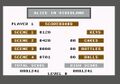
The following list invites you to immortalize yourself with your personal high score. To avoid having to split it into multiple lists, "Alice in Videoland" can be played at any difficulty level.

- Equinoxe - 5563 (29.11.2023)
- Stephan64 - 5508 (04.10.2023)
- Ivanpaduano - 1784 (28.12.2023)
- Shakermaker303 - 1241 (27.04.2025)

|

|
|||
| #2 Stephan64 | #3 Ivanpaduano |
-
 #4 Shakermaker303

Links[edit | edit source]
- C64Games.de - Game No. 1990
- Gamebase64.com - Game No. 218
- Lemon64 - Game No. 79
- C64.com - Game No. 2301
- ready64 - Game No. 3088

- CSDb all entries
- Alice in Videoland at MobyGames

- Magazine
- Telematch Computer Praxis test report (p. 75)

- Computer & Video Games test report (p. 34)
- Tilt test report (p. 36)

- Micro 7 test report (p. 97)


Sources[edit | edit source]
- ↑ Musician HUMM at Video Game Music Preservation Foundation Wiki (vgmpf.com)

- ↑ Oswald Reim, Martin Scholer: "Rombachs C64-Spieleführer", Rombach, 1984, page 12
