Pole Position (Tronic)

| Pole Position (Tronic) | ||
|---|---|---|
 | ||
| Game No. | 549 | |
| Voting | 6.67 points, 6 votes | |
| Developer | Stephan Pabst | |
| Publisher | Tronic-Verlag | |
| Musician | Stephan Pabst | |
| Release | 1986 | |
| Platform | C64 | |
| Genre | Racing, Overhead | |
| Gamemode | Single player | |
| Operation |   
| |
| Media | Listing in the magazine "Homecomputer" | |
| Language | 
| |
| Information | [2] | |
Description[edit | edit source]
"Pole Position" is a car racing game where the player must cover as much distance as possible on a straight, scrolling road, overtaking competing race cars along the way. During the race, the car must be refueled regularly. Fuel pumps appear randomly on the left and right sides of the road, replenishing the fuel supply when the vehicle touches their nozzle. If the player-controlled car goes onto the grass next to the road or collides with an opponent's race car, it will spin out of control. After the third collision with another car, the vehicle explodes.
 |
 |
 |
Design[edit | edit source]
The game begins directly with the starting grid from a bird's-eye view. After a few seconds, a small figure on the right side of the road gives the starting signal, whereupon all the competitors speed off — and the chase begins. During the race, the track scrolls from top to bottom at the speed of the player's controlled car, so that the car always appears at the same height on the screen and can only be steered left or right. Two bar graphs indicate the remaining time (lower left corner of the screen, light red) and the fuel level (lower right corner, light blue).
Graphics[edit | edit source]
The race track is displayed in standard text mode (screen memory as usual from address $0400, character memory at address $0800). To allow pixel-perfect vertical scrolling, only 24 lines of text are displayed. The race cars are multicolor sprites that are stretched to twice their original size in the X and Y directions, while the fuel pumps are monochrome sprites at a single size. In this way, the VIC supports the detection of refueling.
Sound[edit | edit source]
At the start of the race, the engines of the opposing vehicles can be heard in multiple voices, reproduced by the square wave generators of the SID. Afterward, the sound output is limited to the engine noise of the player's own race car, a warning beep when fuel is low, and possibly background noise for collisions and explosions.
If the player successfully completes at least one full lap, a victory ceremony takes place after the game ends and, if applicable, after the player has entered their score on the high score list. The melody of the French song "Pour aller à la chasse" plays during this ceremony. The following image shows this melody in standard musical notation. For creative reuse, the sheet music is also available as a PDF document (File:PolePositionTronic Theme PDF.pdf) and in ABC musical notation (File:PolePositionTronic Theme.abc.txt).
 |
The song was chosen as the winning melody solely because of its celebratory sound. The fact that the lyrics of the song ("He who wants to go hunting must get up early") can also be interpreted as a mocking commentary on the failed start only occurred to the author after publication.
Settings[edit | edit source]
On a black-and-white television, one's own race car is barely distinguishable from the opposing vehicles (left image in the following gallery). Since the author initially programmed his Commodore 64 using only a black and white television and thus knows the problem from personal experience, he includes an additional BASIC line in the instructions that makes your own car white and the opponent's cars black (right image):
2600 POKE 49448,0: POKE 49480,1
 |
 |
Hints[edit | edit source]
The version of the game available in Gamebase64 is a machine language program that contains the original source code in compressed form. Upon startup, this program first moves the beginning of the user's BASIC memory to address $2281 to make room for the sprite definitions and the modified character set. During the subsequent unpacking process, the source code is written into the C64's main memory exactly as it could have been typed in from the magazine "Homecomputer" at the time, and then executed. It consists mainly of DATA lines containing the machine code of the racing game as well as graphics and sound data.
The question "SHOULD TEST IF THE PROGRAM WAS TYPED CORRECTLY (Y/N)?" can safely be answered with N RETURN : The checksummer takes about 8 minutes to complete its task and will certainly not find any input errors. Those interested in the program code can answer the next question, "DO YOU WANT TO SAVE THE PROGRAM FIRST (Y/N)?", with J RETURN - in this case, the program will terminate and can be saved with SAVE. Entering N RETURN will resume the program.
Finally, you need to decide whether to control the race car via the keyboard (T key) or the joystick (J key).
Control by Keyboard[edit | edit source]
F1 / F3 : Accelerate/Brake
C= / SHIFT : Steer left/right
[21]uarr; / 1 : Switch to the high score list after the game ends/start a new game
Control by Joystick[edit | edit source]
 /
/  : Accelerate/Brake
 /
/  : Steer left/right
↑ / 1 : Switch to the high score list after the game ends/start a new game
Tips[edit | edit source]
Fuel consumption is highest during acceleration. A proactive driving style that avoids unnecessary braking and acceleration is therefore advantageous — ideally, you accelerate the race car to top speed at the start of the game and then only steer.
When refueling, only touch the nozzle, do not drive over the entire pump, as it will explode along with the race car, ending the game. Therefore, maintain a distance of a few pixels from the red and white line while refueling.
The player's race car also explodes upon the third collision with an opponent's vehicle. It may therefore be worthwhile to swerve onto the grass verge next to the track to avoid a collision — the race car will spin out there, but this does not count as an accident.
Solution[edit | edit source]
The goal of the game is to cover as much distance as possible within the given time. To avoid running out of fuel, you must refuel in time. Collisions with other vehicles should be avoided, especially since the vehicle explodes on the third collision.
After some time — approximately 2 minutes of continuous driving at top speed — the first lap is completed, symbolized by a white stripe across the track (see left image in the gallery below). Crossing this stripe qualifies the player for the awards ceremony. At the end of the game (due to lack of time or fuel, or after the car explodes), the player can switch to the high score list by pressing ↑ (middle image in the gallery); the total distance traveled determines the score and ranking. Once the player has entered their name using the keyboard and completed the process with RETURN , the awards ceremony may follow (right image). Pressing 1 then allows the player to start the next race.
 |
 |
 |
Cheats[edit | edit source]
In the CSDb there's a Crack with a Trainer function.
Votes[edit | edit source]
| Voting of the C64-Wiki users (10=the best vote): | ||
| 6.67 points at 6 votes (rank 621). You need to be logged in to cast a vote. |
Critics[edit | edit source]
Stephan64: "I would certainly design some elements of the game quite differently today — especially after watching a Formula 1 race on TV for the first time years later. All the more pleasing, then, that "Pole Position" is still fun today and always tempts you to try again and achieve an even better result. And again. And again!!"
Pattensen Power: "It's not so easy to get far within the time limit! A simple game idea, but fun. Only the alarming low fuel warning put me under stress ;)"
TheRyk: "The driving physics take some getting used to; especially the fact that all the opponents take off at the beginning makes you wonder if you've done something wrong. The race itself is reminiscent of the Autobahn at rush hour: once again, only total idiots on the road, you get cut off, sandwiched, or simply rammed without any humor, and with luck you can just barely escape onto the shoulder, if a gas station isn't exploding... The waiting times between a game over and a new race, until it finally starts again, are also somewhat tedious. As expected, the game can't compete with full-price racers from the mid-80s. However, for a self-developed, typed-in listing, it can even be considered playable. 5 points. To give it more, some situations are simply too unfair from a player's perspective."
Shakermaker303: "Not quite my cup of tea, since it's also incredibly difficult to actually get a gas pump. I prefer Motor Mania from an earlier year."
Miscellaneous[edit | edit source]
Cover[edit | edit source]
The following front page of the magazine "Homecomputer" shows the cover of the issue in which the listing for "Pole Position" was published.

Abdruck[edit | edit source]
The rather dry game instructions from the author were rewritten by the editors of "Homecomputer" magazine in such a way that every reader was happy to type out five pages of DATA lines to enjoy such a sensational game:

Bugs[edit | edit source]
Unfortunately, half a DATA line was omitted when the game was printed, as the excerpt below shows. Since this was the sprite data of a gas pump and a mirror image sprite was defined in the preceding section, this error was easy to correct, but annoying nonetheless. An observant reader even contacted the author via the postal address included in the program code and asked for the correct values. The missing line was then provided in the following issue of the magazine "Homecomputer".

In the game itself, collisions between sprites are not always reliably detected. If this means that a collision with another vehicle goes unnoticed, it is of course an advantage, but in the case of a missed refueling stop, it is a nuisance.
Trivia[edit | edit source]
- The design of the game is inspired by an arcade machine on the Laigueglia seafront in Italy, into which the author and his younger brother spent every 100-lire coin they could get their hands on during a summer vacation.
- Originally, the game could only be controlled via the keyboard; joystick controls were added shortly before publication. The author had spent so much on his Commodore 64 (748 DM from Quelle mail order, plus 39 DM for "The Machine Language Book for the Commodore 64" by Data Becker) that he initially lacked the funds for joysticks. Fortunately, his grandmother, who wasn't very tech-savvy but always understanding, contributed a Datasette for another 129.50 DM.
- When programming, the game was entered directly as DATA lines, and the offset of the relative jumps was counted manually. The author can still recite most of the opcodes required for this programming style from memory.
- The author's royalties for publications in the magazine "Homecomputer" were 120 DM per page. For printing a total of 6 pages (description and listing of the game), the author received 720 DM — and was thus able to afford a Commodore 128D some time later.
 |
Highscore[edit | edit source]

- Riffislam - 133.200 (04.06.2021)
- Stephan64 - 131.785 (20.05.2021)
- TheRyk - 60.854 (24.04.2025)
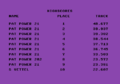
- Pattensen Power - 40.677 (24.05.2021)
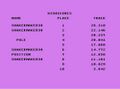
- Shakermaker303 - 28.310 (25.04.2026)

|

|
|||
| #2 Stephan64 | #3 TheRyk |
-
 #4 Pattensen Power
 -
 #5 Shakermaker303


Links[edit | edit source]
- Magazine
- Homecomputer listing (pp. 37-40,46-47)

